Bird perches, toys. Safe & harmful perch wood.
For, cockatoos, parrots, parakeets, cockatiels, conures, quakers, finches, budgies, African grey parrots, macaws, canaries. This page is presented as a unit, not just 2 lists to skim over. Be sure to include the paragraphs as context for the lists.
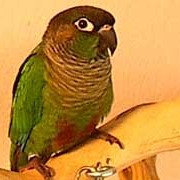
Copyright 2004 - 2020 by M. D. Vaden | Image: Gizmo, a Green Cheek Conure
The safe & harmful woods lists are for pet birds , pertaining to trees or woody plants used for bird toys and perches in bird cages, aviary or flight cages. Each update becomes a more recent copyright. I do not mind others linking to this page, but it should not be republished by others without written approval. This information is not presented as a guarantee, but a gathering of information, sorted further according to my own experience.
Updated July 2018
For starters, selecting a cage that is the biggest you can afford, then maybe double it. It will be a home. When we doubled or tripled cage size for our birds, improved behavior was immediate. A few cubic feet separate a bird cage home from just a mere confine. This is not a wood safety thing. But I want to open the page with this first, because I get disgusted about people stuffing pet birds into the small cages. If you can't afford to be generous, find the animal a new home, or do not get one in the first place.

advertisement
Lists below indicate wood to use or avoid for bird perches. This perch wood list assumes perches are clean and void of fruit and leaves. Most information refers to wood in it's natural state with bark. I compiled information from avian vets and reliable resources, then refined that with my arborist background. The unsafe list has plants potentially dangerous to birds. No tender plants are listed, but some shrubs and vines with firm stems that could be improvised as perches are included. Pine in the safe list refers to branches, not lumber. Beware of residue on stems. Residue that may be overlooked includes moss control products that splash off roofs, sprays for holiday season foliage, decks, weeds , etc.. Avoid sides of a highway or railroad since right-of-ways can be blasted for weed control.
What you see on this page is all I am aware of !!
If you know facts about wood I am not aware of, please send a note. Please, No emails about other wood or species not listed, because this list and text is the entirety of my knowledge or awareness on this subject.
FYI "implicated" isn't good enough. Lately, someone wrote about one species' wood being "implicated" for a condition in humans. Words that matter are "proven" ... "documented" ... etc.. Implicated is a word which News Reporters use to cover their behinds. I'm not looking for suspects, but facts. Not connoted, but rather "denoted". Please keep that in mind when preparing your note. Short, factual and affirmative.
I give priority to reply time on business related messages like estimate requests, so don't be surprised if my reply is brief. If you have something new to add here or a thank you, feel free to write.
Also, plants we see wild birds on should not all be considered safe for pet birds. And wood that is bad for a few birds maybe should be considered bad for all birds. “All for One, and One for All”.
Some difference of opinion was found. Apple for example. Sources like Gillian Willis, said apple is safe: others say it may be harmful. I put it in the safe list due to Gillian Willis' expertise and my opinion that insecticide was the likely culprit for isolated problems.
Elm is on safe wood list. But in many cities, elms are are treated. So maybe refrain from elm because there is an abundance of other wood that is pesticide-free. Call the urban forestry department to find out if street canopy is sprayed. If your yard is maintained by a company, ask if any products are applied.
Bad wood - left columnALDER - red alder -see Alder Buckthorn paragraph |
Safe wood - right columnACACIA - Silk Tree would be in this groupAPPLE - (Insecticide residue likely cause for periodic issues) AILANTHUS - Tree of Heaven ALDER - white alder - (See paragraph about Alder / Buckthorn) ALMOND ARALIA - Fatsia japonica ASH - Fraxinus ASPEN - Populus BAMBOO BARBERRY- Berberis BIRCH - see paragraph BEECH - Fagus BOIS D'ARC - horse apple tree BOTTLE BRUSH BUTTERFLY BUSH CAMELLIA CITRUS - (lime, kumquat, grapefruit, orange, lemon) CORK - (not wood from cork oak, but cork) CORN PLANTS COTTONWOOD - Populus CRABAPPLE - Malus CRAPE MYRTLE - (not the same as myrtle) DATE DOGWOOD - Cornus DOUGLAS FIR - Pseudotsuga DRACAENA ELM - Ulmus ESCALLONIA EUCALYPTUS FIG FIR - genus Abies GINKGO GRAPE VINES GRAPE PALM GUAVA HACKBERRY HAWTHORN - Crataegus HIBISCUS HICKORY IRONWOOD - apparently toxic leaves JADE PLANT KALANCHOE LARCH - Larix LILAC - Syringa MADRONA / MADRONE - Arbutus MAGNOLIA MAPLE - Acer - see Maple Paragraph MANZANITA - Arctostaphylos MESQUITE - remove sharp parts MIMOSA MOUNTAIN ASH - Sorbus MULBERRY - Morus - see Mulberry note NANDINA -common name is heavenly bamboo NORFOLK ISLAND PINE - Araucaria NUT TREES - exclude chestnut ORANGE - several sources lean toward safe OREGON GRAPE - Mahonia PALM PAPAYA PEAR PECAN PINE - Pinus: see Pine paragraph below PHOTINIA see Photinia paragraph below POPLAR - Populus PUSSY WILLOW - Salix RAPHIOLEPSIS - Indian Hawthorn RIBBONWOOD ROSE - Rosa RUBBER PLANT - Ficus elastica - Weeping Fig in bad column RUSSIAN OLIVE SASSAFRAS SILK TREE SPIRAEA SPRUCE - Picea STAGHORN SUMAC - see Sumac paragraph STRAWBERRY TREE - Arbutus like Madrone SWEET GUM SYCAMORE THURLOW TREE FERN VIBURNUM VINE MAPLE - Acer WEEPING WILLOW - Salix - see Willow paragraph WIEGELA YUCCA We get a lot of email from folks who don't see a wood named on these lists, but ask if another they have in mind is safe for their bird. They need to understand that this is the sum of what we are aware of. This was not written to selectively withhold useful wood names. What you read here is what we know of. But we are always open to new safe wood names if you have a source to provide with the suggestion. |
Ailanthus altissima / Tree-of-Heaven, China Sumac Also called the Ghetto Palm. The following was posted on the Perdue University website about, and seemed worth sharing the comment: Source: James A. Duke. 1983. Handbook of Energy Crops. unpublished.
"Leaves are toxic to domestic animals (Perry, 1980). Gardeners who fell the tree may suffer rashes. Mitchell and Rook's observations are more violent than my own to sniffing the leaves, "The odour of the foliage is intensely disagreeable and can cause headache and nausea...rhinitis and conjunctivitis...The pollen can cause hay fever." (Mitchell and Rook, 1979)."
This caught my attention when this species became a topic of discussion on a arboricultural forum. The article just points out leaf toxicity. And for the present, I will leave it in the wood safe column. The is a fairly lengthy Wikipedia Topic for this species. The potential for rash appears anecdotal. One Canadian government information system site wrote " However, convincing documentation ... lacking". Little seems more than "may have"
Fertilizer Someone emailed about whether fruit wood is safe after fertilizing. My 1st question was if they still had the package. Most fertilizers supply elements that are found in soil anyway, like iron or nitrogen. Whether fertilizer is sythetic or organic, it's purpose is to supply one or more of just 17 Essential elements. And if that's all that was applied, the wood should be fine for perches. But some fertilizers may have fungicides or insecticides added: systemic ones. That's why you would need to read the entire package to make sure that it was basic fertilizer for nutrition purposes only. Also, you might want to avoid branches where fertilizer was applied foliar from above: like sprayed on. But if plain fertilizer was added to soil only, the wood should be okay.
Lumber wood information Pressure injected wood: don’t use it for birds: perches, toys or structures. Also, if you find lumber, do you know what contacted it? It's like an unbroken chain of possession for evidence. If you left lumber in a shed that several people use and haven’t been there for a year, how do you know what may have spilled? What kind of dust settled? Most light pine lumber in stores is not coated with anything. But ask anyway. Pre-cut stakes, such as those used for surveying, may have been coated due to the need to remain in the ground. We can’t be certain 100% of the time, but every piece of information brings us nearer 100% accuracy. A square edge perch is not a good. You could remove square edges, and round wood is better. Natural branches are the best because the diameter differs from small to large, allowing birds feet to stretch and contract.
Aromatic Substances Refer to other bird sites for aromatic info. But I'm leaving this comment about Teflon. Switch from Teflon pans to something like stainless steel or cast iron. Teflon pans over-heating, can emit substances deadly to birds. We try to keep perfume, aromatic scents and colognes to an absolute minimum at our home.
Check Plant Names For our lists, or others, check common names to know the genus, scientific name and common name. For example, Douglas fir is not a fir. Western cedar is not a cedar.
Balsa Wood This is our birds favorite to play with. Most sources indicate that balsa is safe for birds. I contacted avian veterinarians in Oregon and California, and got the same feedback - that balsa wood is fine. You won’t want balsa for a perch. A cockatiel can chew through balsa in minutes.
Cleaning Wood One philosophy says clean bird perch wood before it’s used by soaking for an hour or two in tub of water with a cap of household bleach. Then rinse the wood in clean water. Another says Chlorine bleach may cause an occasional sickness or fatality. Maybe due to too strong of a solution. The second philosophy may use mild soap and water solution followed by rinsing with clean water. Both viewpoints agree about allowing wood to dry thoroughly, including exposed to direct sunlight. Oven drying needs to be hot enough to kill microbes, but cool enough to avoid combustion.
Alder is not Alder Buckthorn - The 2 alders One person emailed a concern about a substance Cascara sagrada acting as laxative. Its made from bark of Buckthorn with a common name Alder Buckthorn. Its not an Alder or Alnus. Buckthorn is Rhamnus purshiana. To my knowledge, Alnus has no Cascara sagrada. Red Alder On a USDA Forest Service Pacific NW lumber page, was a footnote for red alder "Toxicity: can cause dermatitis". Red alder is not the only alder we have in Oregon. There is also Alnus rhombifolia called white alder. A source about white alder for use by Ohlone Indians, said they used it for diarrhea. My conclusion: avoid Re Alder.
Note: January, 1, 2010, I read from Univ. of B.C. that Rhamnus purshiana is now called Frangula purshiana. Apparently something that has gone back and forth previously in the past couple of centuries.
Birch The following comments are a PARAPHRASE from Gillian Willis - author - with clarification:
Birch is Betula species. LEAVES & BARK contain salicylates and a few substances ... . The low concentration ... Birch should be considered safe for natural wood perches. The seeds inside the cones are a special goodie safe for birds to eat. (end of paraphrase) Think: Automobile fumes can be damaging. We don't want to be enclosed where the fumes are trapped. But walking down the street where those fumes are in the air at low concentrations, we feel safe to breath. As noted, Birch should be considered safe and the risk of leaving bark is inconsequential.
Cherry Some sources debate about cherry wood being bad to pet birds, for a lack of substantial confirmed cases - although confirmed cases of problems for a few dogs and horses is apparent. Some folks lean toward using cherry wood, but not the bark, under the premise that the chemicals are primarily in the cambium - layer under the bark. Do you know what that layer is? Do you see what I'm getting at here? When there are an abundance of sure safe woods, why use one that has bark with potential bad stuff in it? Suppose there are no confirmed cases of dead birds from cherry. If cherry turns out to be a subtle problem, would you want your bird to be the first confirmed case? I suspect there are cases not documented. There must be hundreds of birds dying each year due to real causes that we don't know about.
Driftwood Driftwood is not recommended for a few reasons: 1. There is no certainty for the average person about the tree genus. 2. The ocean water environment contains organisms not to mention every kind of animal waste in addition to residue from ships. It is an uncertain environment. 3. Driftwood can have high salt content. Imagine all the crud that embeds into that wood.
Ironwood Hop-Hornbeam called Ironwood and American Hornbeam, is added here to clarify what kind of email will make it to this page. I am after safe wood information and not so much leaf info. Someone shared a factual research link, showing that this Ostrya virginiana has cyanogenic glycosides in leaves, but nothing said about wood. (Science Direct article). Wild birds like the seeds. The hard wood is good for fence posts or tools. So people could choose it for perches. Without facts about wood, I can't say, and reduced the message to this paragraph. The note was in the ballpark of info worth sending; just shy of making the wood list above.
Larch or Dawn Redwood - Larch is in the safe wood list. In case you did not know it, Larch is a deciduous conifer. It looses it's needles in winter. The needles are attached in little clusters on pegs like little tufts. There is another tree Dawn Redwood which is also a deciduous conifer. It's needles are attached to the twigs individually and somewhat two-ranked on either side of the twig. Initially, new spring growth looks like little tufts, but these elongate into tiny mini-twigs lined with ranks of individual needles. Dawn Redwood is not on the list above. It's genus is Metasequoia (sp. glyptostroboides). Avoid using Dawn Redwood - feel free to use limbs from Larch (Larix).
Linden The Linden is such a common species, I was surprise it was not included when I started this page back in 2004. Somebody inquired about Linden for perches in 2018, and I replied, because their question was identification related with photos of seeds and leaves. After identifying it for them, they found some information. Here is what they wrote in a followup email:
"I did some research and found the following links. This website lists Linden as not having any toxic affects on animals: https://vcahospitals.com/know-your-pet/plants-safe-for-birds . This next website says that wild birds will consume the buds and leaves, but also notes that so far there has not been any documentation of the affects they would have on domesticated birds: http://africangreyparrot.info/thread/3588 ... This last link has links to some websites that have listed it as safe http://forums.avianavenue.com/index.php?threads/basswood-safe.8662 ... Hopefully these can help. (Mileidy C.)"
Maple Originally, this page only listed two maple trees: vine maple as safe, and red maple as potentially harmful. I've included "maple" in the safe list now, but with this condition: remove the bark. It may not be absolutely neccessary, but its the only way that I'll suggest most of that tree genus. From what I've read, the bark of many maple trees, like vine maple or Japanese maple, etc., is fine. Meaning, the bark in itself is not deemed a problem. But red maple (Acer rubrum) can harbor a fungus. Inhalation of exuded residue may be harmful. Maple wood - in general - should be safe for natural wood bird perches once bark is removed. One source wrote that "red maple" is bad for horses, not really specifying why. Currently, I'd use almost any maple branch for a bird toy or perch..
Note about an Acer (Maple) called Boxelder. I do not know the reason sources I found have "maple" mostly as safe wood and "Boxelder" as unsafe. Boxelder does look unusual to most people as a maple because the leaf shape is very different from the stereotypical maple leaf shape. So maybe there's more different than just the way the leaves look. And hardly anybody calls it "maple", even in the landscape trade. So treat Boxelder as if it were not maple pertaining to the bird and wood thing.
Mulberrry / Morus (report) In September 2012, I got an email related to Mulberry. The person said their vet ID'd the plant. No specific species given, or ID photos to prove how the vet concluded identification. Below, are parts of the email ...
"just had a pair of scarlet-chested parrots at the vet for two nights due to mulberry branches having a diuretic effect and causing severe diarrhea and weight loss. It would be worth noting then that they are not safe for all species and use of mulberry leaves should be avoided with the neophema group. " And ... [quote] "I work in a pet shop and leaves from the same tree were given to birds there as well, and again it was only the scarlet chested parrots that had anynoticeable reactions."
The note specified "leaves", but I clearly open this page in the first sentences that my lists assume branches are free of leaves and fruit. Thought the message may be of interest anyway.
Pine We read an article about Pine and Cedar containing compounds that can cause lung or sinus problems. But the article was about bedding like shavings put in bottoms of animal cages; more common for hampsters and other pets; rarely for parrots or cockatiels. When we listed pine above, that meant as perch wood which this page is primarly intended for.
Pine is one of the species I would be less likely to use due to the type of sticky pitch that often oozes from it or beads-up on the bark. If I used branches, I would most likely let the wood age for 4 to 8 months, not just a matter of days, so any pitch would manifest itself.
But we have used pine wood from the hardware store often to build little boxes and stuff. I select the wood for boards without signs of pitch or sticky surfaces. Then I let it sit for months to see if the wood's inside bleeds any pitch spots or areas.
Pitch in the pine will be an awful thing for bird feathers. And although I have not asked any vets yet, I suspect some pitch can be sticky enough to hold a beak together unless its cleaned. Don't know for certain, but wouldn't surprise me.
The preponderance of sources I find indicate that pine cones are okay for parrots, etc., but those have to be checked for pitch spots too. Sites that recommend cones say to heat them in the oven for a while, and to select ones that have not been laying around too long on the ground, like sitting all winter or with moss. Since they can burn, watch your temp and time carefully.
Photinia In May 2010, someone told me that Photonia leaves have Arsenic in them, and was toxic to horses. The only reference I could find online was a New Zealand Alpaca site with a table listing Photinia leaves as toxic with Arsenic. But no other references. Then I found a website of a Manes and Tails Organization, which included excerpts from The Merck Veterinarian Manual: Poisonous Range Plants of Temperate North America. The notes stated: Cyanogenic glycosides in foliage and fruits, hydrolyzed in GI tract to free cyanide, thereby affecting cellular respiration.
Keep in mind that the reference was about foliage on a grazing animal website. and that my page here deals with woods or branches expected to be free of leaves, fruit or flowers. Just the branches. So I still believe that Photinia wood is fine for bird perches. I was still glad to find the information though.
Sumac - Rhus One sumac on this page is Staghorn Sumac - a safe tree. And the genus is Rhus. Its fruit berries have been clean washed and made into a good lemonade when sweetened. Native American Indians even mixed its leaves and fruit with tobacco for smoking. A broad range of plants may be called sumac, some safe, some not. Some species in the genus Rhus are potent and can also cause severe skin irritation to some people. Other species like Rhus typhina are not bad. Most naught species have axillary panicles and smooth fruits. The okay species have upright, dense, conical drupe type fruits, covered with crimson hairs.
Walnut - quote from an email sent from Pennsylvania
Start Quote "Here is my personal experience with black walnut trees in Pennsylvania. I got my two birds (Goffin's Cockatoo & Sun conure) in November 1996. In April 1997 I bought a house for us. My avian vet said black walnut was OK to use for perches, but to let it dry first. Over the years, squirrels have filled my yard with these trees. Since summer 1997 I have used black walnut branches & tree trunks, fresh-cut and green, with leaflets attached, as perches. My birds love to destroy the foliage, and then chew the bark off. Black Walnut and Manzanita are the only woods I have used for perches in all this time. (Note: no pesticides, fertilizers or any other chemicals are used in my yard.) They also love the walnuts that I crack with a brick. We recently had a "good" health check - my conure is now 18 and sadly, starting to get a bit cranky. We have had no adverse effects from 17 years of chewing on fresh black walnut wood"End Quote
My thoughts ...
The email had the senders name, and did not name which avian vet, but I believe the message is a real experience. First thing ... my page is devoted to birds as a whole, not just one person's birds. And whereas this person's parrots destroyed and chewed leaves, it does not say they ate them. Maybe other birds would eat the leaves or a little bark. The note relays that the vet said Black Walnut was okay for perches ... nothing about playtoy aspects of leaves or bark, nor other kinds of Walnut. If their avian vet is up to speed on recent knowledge, this would leave me more confident in at least one kind of Walnut. Except ... with so many other species having a more solid reputation, I would probably try and use another kind of wood. If I did use Walnut, all the leaves, bark and acorns would be completely removed ... FWIW ... note that the avian vet said to dry the wood first, but the person apparently went beyond that professional advice. Not sure whether it was based on extra advice not mentioned, or merely personal choice.
Apparently Walnut has much less tannins in wood than leaves or acorns, so that may be why the avian vet went with the recommedation.
Willow Someone sent me a URL for a University of Maryland University medical center page about some willows, and and how the bark contains salicin: similar to aspirin (acetylsalicylic acid). Apparently the wood does not contain the compound like the bark does. One excerpt reads:
"The willow family includes a number of different species ... ... Some of the more commonly known are white willow/European willow (Salix alba), black willow/pussy willow (Salix nigra), crack willow (Salix fragilis), purple willow (Salix purpurea), and weeping willow (Salix babylonica). The willow bark sold in Europe and the United States usually includes a combination of the bark from white, purple, and crack willows"
The article sounds reliable, and apparently the bark and compounds are effective for human use it they are not allergic to it. Based on that information, I would still be very inclined to use willow wood for parrot perches or bird stands. But would remove the bark. And if the branch is freshly cut, will be among the easiest to remove. I used this for hiking sticks, and in the spring, bark virtually peels off by hand. If its dry, just use a knife.
VINYL FLOORING CAUTION
Few things are added to this page beside wood and branches. But we experienced a problem with new vinyl flooring that seemed worth sharing. We decided to give them an entire small bedroom downstairs for an aviary. And laid about 10' x 11' of brand new vinyl flooring. No adhesives used. In the afternoon, we put the birds in the room for a couple of hours to get used to the space. I went down to check on them, and the male Green Cheek Conure was having trouble breathing and was leaning back hard on a branch. The female was in the cage also having problems breathing. I immediately took them upstairs. Anyway, in about 1/2 hour, they were in very good shape, back to themselves again. My best estimate, is that another 30 minutes in the room, would have been the end of at least one bird. We knew the stuff a smell to it, but never realized that it was hazardous to them. Just thought of it a a new product smell. I could not find anything online either.
Some of you may be aware of this issue from experience or something your read. For those who are not aware, there you are. The smell was mostly gone in a few days. At that point, we took the birds down for like an hour per day, for several days. About 1 week later was the first full day. But we had them sleep upstairs in a second cage for the 8th and 9th nights. It was about the 10th night we let them sleep in their cage in the new aviary room. Always leaving the door open too: all day. I built a 30" tall barricade to put in front of the door so they can't walk out. The wings are clipped. We try our best. And in this situation, I think "the Man upstairs" somehow got us to intervene in time.
Bird Related Links
The Association of Avian Vets
Birds N Ways
Parrot Pages
Birds n Ways
Cockatoo Heaven
Conures
The Blue Macaws
Parrot Pages
Safe wood for birds | Safe wood for parrots | bird safe wood | parrot safe wood | parrots and trees | parrots and branches | perches for birds | conures | parrots | budgies | cockatiels | quakers | cockatoos | perch | cage