Sunscald and sunburn to trees and other plants
Copyright 2006 - 20014 by Mario D. Vaden
In the literal sense, winter sunscald is a figure of speech in regard to sun burning the trunk but real regarding freeze damage following a sunny cold season day. The name is misleading. Sunburn from the sun happens in the summer from improper plant care. But in winter the sunscald culprit is a freeze damage that I find much less often in Oregon than actual sunburn.

advertisement
Here are some of the most important things to avoid sunburn damage in your landscaping ...
1. When selecting trees in a nursery, a tree on the west or sunset end of an east-to-west row may have been sunburned if the nursery didn't shade or wrap the trunk. Or if someone removes an end tree exposing the next tree (previously shaded).
2. Raising a canopy too much at one time particularly between May and August can bring too much sun immediately to bark that was shaded. That's if it's the side facing the sunset or afternoon sun. Either raise in small increments, wait for the cool season, or if you absolutely must raise the canopy, then wrap the bark to shade it.
3. In the warm season, if you remove an adjacent tree, structure, or thing, that exposes bark to hot sun, then sunburn is very possible. For this reason, some tree removals are best postponed for the autumn or winter.
4. It's often best to prune fruit trees like apple in the cool or dormant season anyway, but May to August is the worst time to remove a lot of top growth or water sprouts. That's a common cause of sunburn on top of the main limbs.
These are 2 different types of bark damage. The winter plant damage is usually to the lower trunk. The summer plant damage frequently occurs to the lower trunk, but is not uncommon to find in the upper canopy.
Sunburn damage is not very comparable to sunburned skin on humans. Both type of tissue injury result from exposure to sunlight. But skin damaged by sun usually shows near immediate symptoms like discoloration. But when woody plants in a landscape or garden are affected by sunlight, the damage is usually not immediately visible.
The bark doesn't turn red the same day that the sun related damage occured, and typically, it doesn't start peeling or blistering during the next few days or weeks. In many cases, the damage is visually evident after many months or several years, when bark starts to crack, come loose, fall off, or even discolor.
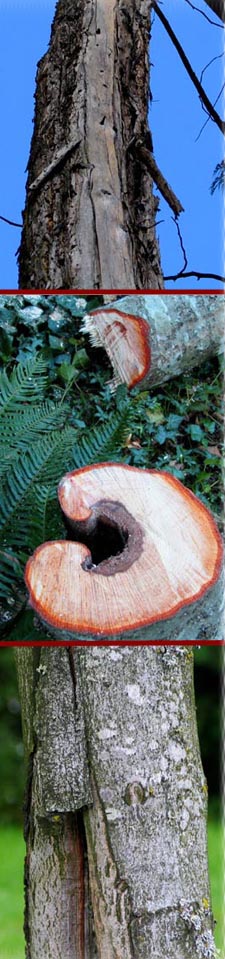
The images to the right are all real warm season sunburn, not the winter damage figuratively called "sunscald" The top of the photo was an evergreen at some condominiums where other protective plants were removed for building. The middle image was an ash or Fraxinus burned because woody plants and branches were removed from the neighbors yard. The cross-cut during removal shows the interior damage and the tree's attempt to callus over the injury. The bottom photo was one of 30 consecutive newly planted flowering cherry in Portland that all became sun damaged from lack of trunk protection after planting.
Winter freezing, called "sunscald" is similar but not identical. But to many people, the basic damage may look the same. Most important to realize is that summer sunburn far exceeds winter sunscald (freeze)..
There are quite a few sunburned tree trunks in Oregon forests, even in landscaped yards. One of the worst problems appears to be with newly planted trees that don't receive trunk protection for the first few months to few years. Material to wrap or cover trunks is easy find and purchase. A protective wrap helps new trees adjust to warm summer sun, but many people are unaware of that practice and the benefits.
With exceptions,most sun damaged trees in our state are where man has been active - actively changing landscaping or property. Either people moved trees into sun from shaded nursery rows, or they removed foliage that previously protected tree trunks on the south and west (sunset) side. That can be done by removing too many branches or removing trees that provided shade. Even a dead tree can provide some shade, so removals of dead trees can trigger sunburn to remaining trees.
It is possible to get a winter injury. Here's a fragment of text from the Virginia Polytechnic Institute and State University:
"...Mid-winter freezing often takes the form of bark splitting. On a relatively warm day, the sun can really heat up dark-colored tree trunks and get the sap flowing; if a severe freeze occurs that night, the bark MAY split..."
That's not a sunburn. It's referring to a splitting of the bark. If by chance sun warms bark first, then freezing at later at night, it becomes possible for bark to split. Not common, but possible.
If you have a tree you are concerned about, it would be better to temporarily shade the trunk with some window screen or some other material.
Some university sources recommended a shade cloth too, such as burlap temporarily. Paint was mentioned, but cloth and screening can be removed.
Here is a version from Perdue University:
"Direct sunshine onyoung thin-barked trees warms the bark considerably. But when the sun goes down, air temperatures drop rapidly, and that can result in the ... bark splitting ...... Shading young, thin-barked ... such as maples and fruit ... on the south and west sides will help prevent bark splits from temperature extremes.
The bark tends to split vertically on the sunny side of the tree, because as the temperatures drop rapidly at sundown, the outer bark cools down and contracts faster than the inner bark. Thus, the outer bark must split to accommodate what's below. Wrapping the trunks with commercial tree wrap provides some protection."
Here is one from Washington State University:
"Sunscald occurs on sunny days in winter when the bark ... is warmed by the sun, especially on the southwest side of the trunk. The bark and cambial tissues deacclimate and are not able to reacclimate quickly enough when the sun sets and the temperature drops abruptly. The result is damage or death of tissue."
(Note comment about abrupt temperature drop: "sunscald" is a figurative phrase)
And another from the University of Georgia:
"Although not common in Georgia, frost cracks on the trunks ... can occur in sections of the state when plants are exposed to extremely cold temperatures. A frost crack is a long, deep, narrow crevice running up and down the trunk .... As temperatures cool down, the temperature of the trunk drops quickly and the trunk contracts and may split."
No two explanations are exactly the same. The similar parts conclude that the injury is not a "burn" from the sun during the day time warming.
There are manufactured protective trunk wrap materials available from local nurseries or garden centers. One of our favorite choices is a window screen material. It breaths, it shades and it does not store heat. It can be single or double wrapped. Window screen is one that I have used often. It cuts easy with scissors, and can be tied or stapled together.
The worst protective trunk protectors for light, are the dark ones that block almost all sunlight. Those do not allow woody plants stems to acclimate. A light screen allows some light in so the trunk can slowly adjust to the sunlight. These wraps are handy for summer protection, or for winter protection for young trees with thin bark.
The image above is comprised of several images from my photo album. Other photos there may be of interest - a wide variety of photos about several things. See albums in the menu.