
Dangling Climbers
by Mario Vaden
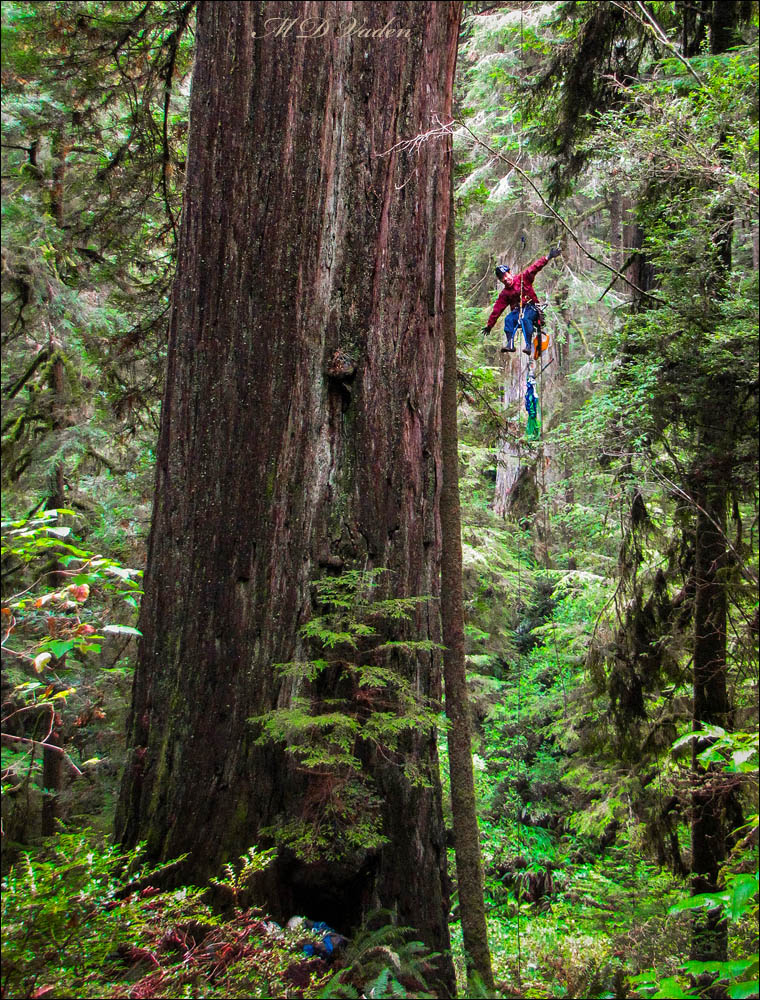
I hoped this would be an interesting educational twist. Spotting a redwood with an ascending researcher is a rare and unusual sight. Around 2012, and years following, parks or visitor centers began hiding photos and information about people doing research climbing. But in my opinion the effort required to study coast redwoods is worth teaching so more people can appreciate the work. And it may inspire a few others to take up this line of work.
For a number of years it was the researchers who covered expenses "on their own dime". Eventually contributions grew.
The ascent takes several steps. First, a crossbow is aimed at a strong limb far overhead sending a rubber tipped arrow that elevates a strong fishing line upward and downward as the arrow falls back to earth. Next, the fishing line is used to pull a thin rope back up and over the same limb. And the thin rope is used to pull a very strong climbing line up and over the limb. The climbing line will be upward of 400 ft. to 500 ft. length. Research climbers climb up using friction devices called ascenders, making the climb seem like a ladder-like movement. Once they reach the canopy, a variety of lanyards, ropes, pulleys and other tools are used. Much of the research available to read, or photos National Geographic captured, were accomplished with the aid of these climbing techniques. The photo below shows researcher Dr. Hiroaki Ishii from Japan, ascending in Jedediah Smith park in a research plot about a 30 minute bushwhack from the vicinity of Boy Scout tree.
The crossbow gained an extra use the week this photo was taken. The group needed to stretch a very long measuring tape straight across a ravine but had difficulty raising it over a tangle of vine maple branches. They fired the line and rubber tip arrow horizontally across, as a tool to pull the tape to the other side.

advertisement