
Tallest Port Orford Cedar
81.08 meters, 266 ft. and 73.1 meters, 240 ft.
Tallest Chamaecyparis lawsoniana discovery 2009. Jedediah Smith Redwoods.
Continued from: Main Coast Redwood Page
by Mario D. Vaden
It is worth interjecting that the Port Orford cedar species is far more endangered than coast redwood. The natural range is much smaller, most of the largest were logged and harvested, and to add greater challenge, there is a pathogen to complicate survival. But this species has no "Save the Port Orford cedars League" like the coast redwoods or giant sequoias.

advertisement
Back in 2009, I did some exploring with Dr. Steve Sillett and Dr. Robert Van Pelt, across Jedediah Smith Redwoods State Park. This was September 2, 2009. Toward the afternoon, Steve caught a glimpse of the tall trunk perched in one of the many small valleys. In a matter of minutes, we learned it was a new height world record for Port Orford Cedar.
Chris Atkins was the only other person who has been here. The photo below shows inside the crown of the Port Orford Cedar found in 2009. The upper branches are covered with moss that took residence high up in the canopy. Continue reading below.
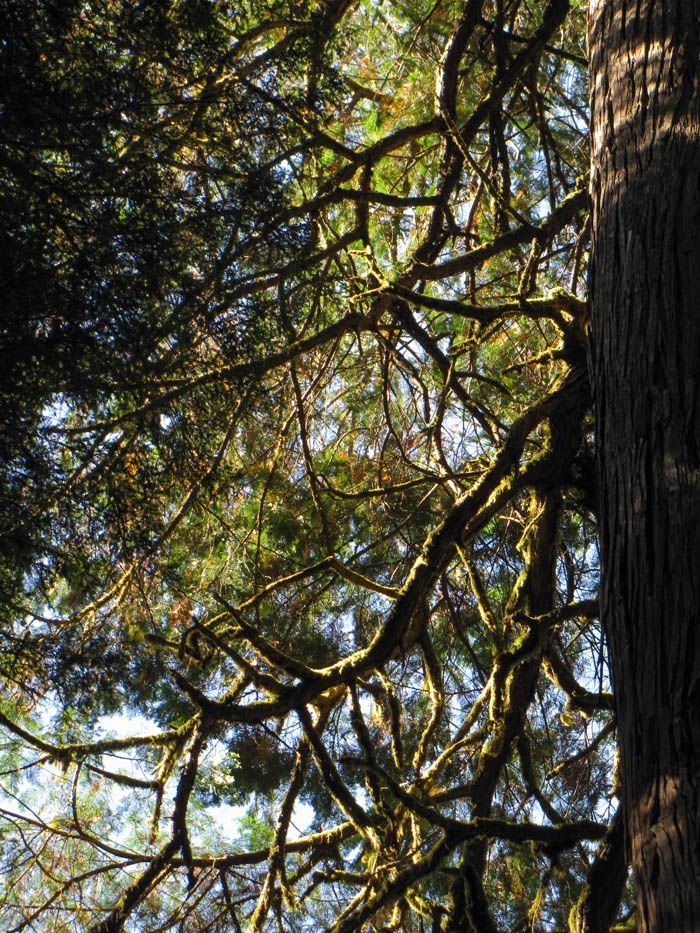
It measured 81.08 meters to the top, with live foliage up to 77.42 meters. The trunk dbh measured 280.4 centimeters or 9.1 feet.
The next tallest known was 238.8 feet in Coquille Falls Research Natural Area, Siskiyou National Forest, Oregon. I read an article or notes by Jefferson Public Radio noting a 248 foot world record. But I think it was a typo adding 10 feet to the one nearr Coquille.
Update: June 26, 2018, while exploring with Chris Atkins, we discovered another tall Port Orford Cedar in Jedediah Smith Park, about 4 hours up the Clarks Creek drainage. We didn't have time to pinpoint a final measurement, but between a few laser increments and our combined guesstimate, believe no less than 240 feet tall with a diameter close to 8 ft. dbh. The Clarks Creek drainage seems to have more Port Orford cedar and western redcedar than other regions of the park. Continue reading below.
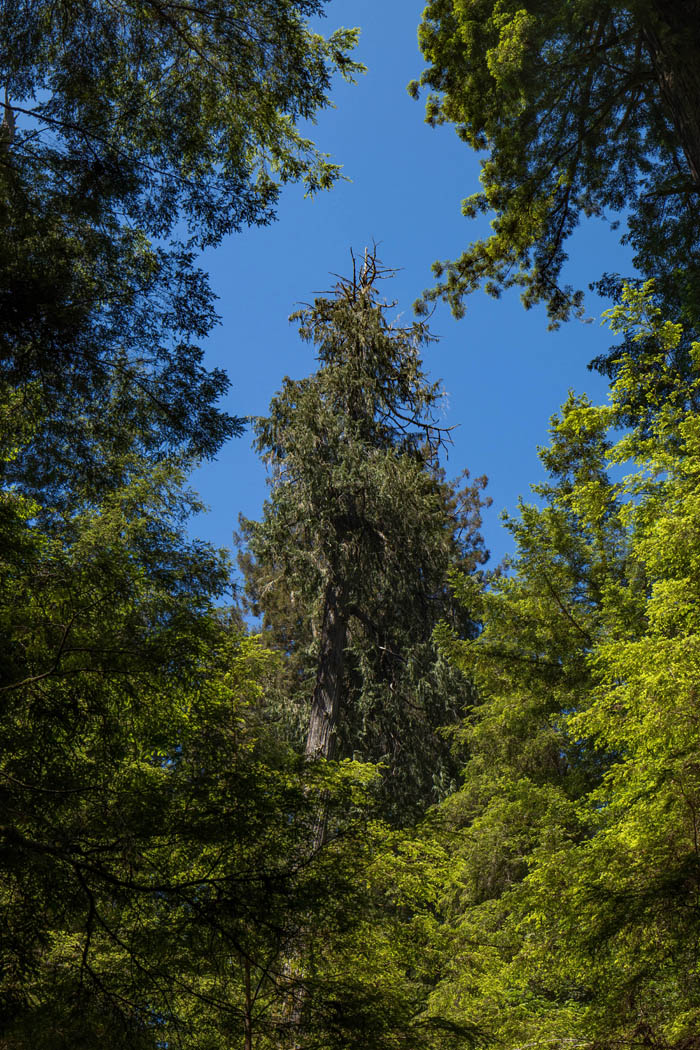
We called the 2018 find "Bronze Medal" because there was actually one more very tall Port Orford Cedar by the 266 footer. Those will be referred to as "Gold Medal" and "Silver Medal"
The bark of these Port Orford cedar can look like a few of the big younger redwoods, without deep furrows. The foliage difference may be hard to detect if the limbs start up high on the trunk. But there is usually enough on the ground for identification.
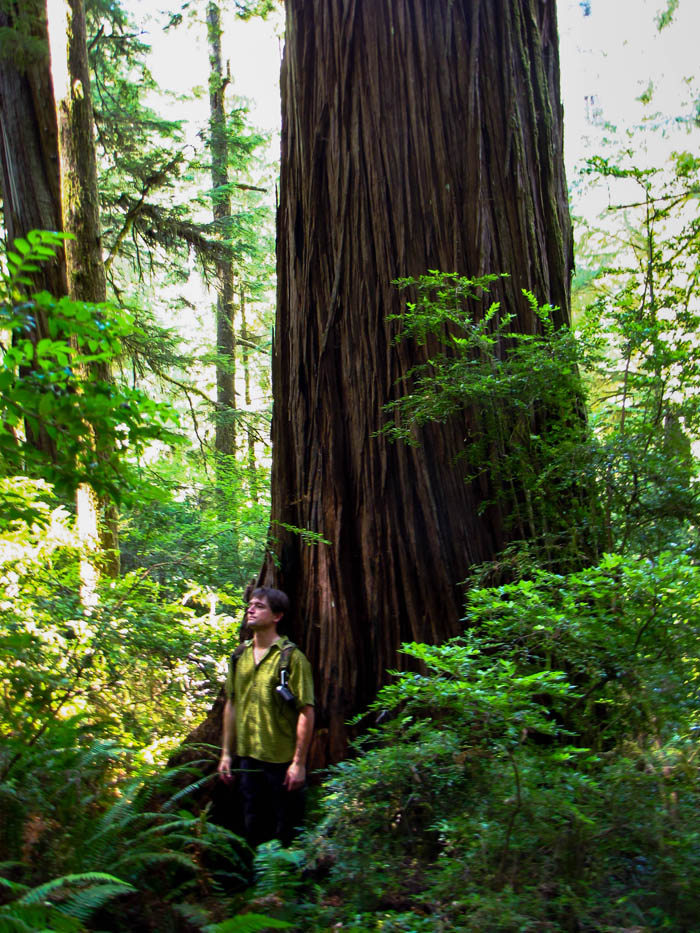
I remember hiking elsewhere on Flint Ridge trail in 2016, when the foliage challenge showed it's face. We stopped at an old western redcedar along with friends Mark from back east, and Ed, a retired redwood guide. The foliage was very tiny and hardly any fell to the ground. Ed mentioned how the bark had resemblance to young coast redwoods. Eventually I found a foliage sample on the ground and used a zoom lens to photograph foliage from a distance. The photo and sample indicated western redcedar. That plant identification episode reminded me of 2009 when we found the Port Orford Cedar. It takes a few minutes to ascertain what species.
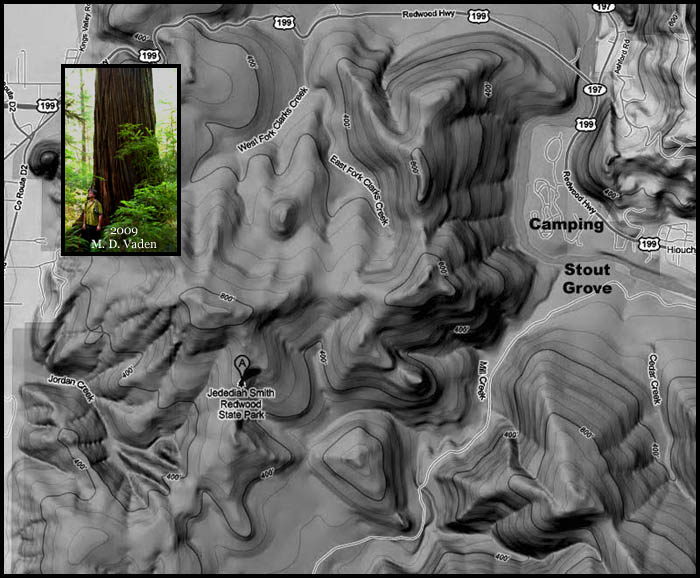
The map below shows some hills and valleys of Jedediah Smith redwoods. You can see how many l valleys there are with protection from wind where super tall conifers can grow. Many of the taller conifers grow in the valleys because there is wind protection, and that's also where water moves as it runs down from the hills. Some of the valleys are also the hardest places to explore because the fallen debris is abundant. And the slopes are steep and slippery.
Port Orford cedar is a large evergreen, maturing 100 - 200 feet tall and more. The trunks can be 4 to 6 feet in diameter or more. There are historic measurement for trunks up to 17 feet diameter. The have feathery foliage in flat sprays, frequently blue-green in color. The leaves are scale-like, 3-5 mm long, with narrow white markings on the underside and flattened shoots. The seed cones are globose, 7-14 mm diameter, with 6-10 scales, green at first, maturing brown in fall, months after spring pollination. They can feel woody like coast redwood but smaller and more round. The male cones are 3-4 mm long, dark red, turning brown after early spring pollen release. The bark is reddish-brown and fibrous or scaly in vertical strips. But my photos shows bark exposed to sun appearing gray too.
Similar, the Western redcedar seems more emerald green with markings under foliage that sometimes look like bow tie or butterfly shapes. Port Orford cedar can have white markings like tiny letter X's. But I find the bluish color to be a good clue in some cases for Port Orford
This species can be damaged by a root disease caused by the fungal pathogen, Phytophthora lateralis. Port Orford cedars are sometimes killed by other species of Phytophthora. This is why you may see signs in the redwood park about this fungus and your boots.