Coast Redwood Forest
Exploring | Measuring | Bushwhacking | Learning
Continued from: Coast Redwoods
Jump to: Tips for Exploring | Bushwhacking

advertisement
Copyright 2009 - 2011 by Mario Vaden ~ Also, see Emergency Kits
The year of 2009 provided a few opportunities explore with Chris Atkins and Professor Steve Sillett in Redwood National Park and Jedediah Smith Redwoods State Park. The days were strenuous, yet enjoyable. Miles of deep forest exploring.
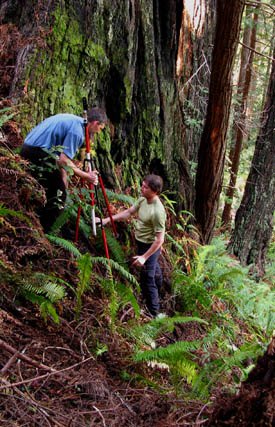
This was an opportunity to see how meticulous they are with data and equipment, and how they work together as a team and as a network of professionals.
Although our focus was redwoods, one find included 2 Port Orford cedar side by side, a new tallest ever-recorded of any cedar-like species. That was within Jedediah Smith redwoods.
We wrapped up another day with a cross country bushwhack to another part of the park where a tall redwood soared overhead: a new 2nd tallest known coast redwood within that park. That redwood became part of a new study plot.
The amount of time to measure a single tree can be substantial. It was surprising in Redwood National Park, to see where Atkns and Sillett set up a tripod across a ravine and about 200 feet upward on steep slope. This image at right shows the terrain. Sillett's head is level with Atkin's knees, and likewise Atkin's head level with my knees while taking the photos.
This led to an opportunity to help Chris Atkins measure some of the tallest redwoods. Every 10 weeks or so, I drove down to the north redwood parks for 2 or 3 days of work. Equipped with GPS for navigation, Atkins packs in a Laser Technology rangefinder and Leica Geosystems surveying prism. My part was to accompany, find the tops, help set up tripods and photograph. Flashlights are essential: at least twice we ran out of daylight in thick woods.
The redwoods we looked for, and will look for, are LIDAR redwoods. Funding from Save the Redwoods League, and Kenneth L. Fisher, funded a plane to fly over some redwood parks to read ground and canopy with laser. About 80,000 pulses of light per second. The data is used to make a type of map which suggests tall redwood hunting grounds. Then we go in there and find the tallest redwoods. Several other men helped with this project too.
This was a good learning experience and I had a chance to see many parts of the park where people just don't go alone, if at all.
2008 was interesting exploration too. November, I met Michael Taylor the first time, at Prairie Creek redwoods. We traveled to forest around Lost Man Creek and Larry Dam Creek. That is where we found Dog Soldier: approximately 21,000 cubic feet. And Michael later found and measured Spiral Stovepipe in there. There are also more LiDAR redwoods in that vicinity.
Bushwhacking Tips | Nature's Call

We all know that some folks are going to go off-trail, even though the rangers prefer otherwise. Its just the nature of the culture down there. So here are some thoughts .....
When you hear Nature's Call . Yes ... pinching a loaf ... going to the bathroom. Ever realized how many people go behind a tree and just leave that bright white paper sitting there? Rather than a quick dump and run, be courteous: grab handfuls of needles, twigs or duf, and cover your pile and paper. It will retain moisture, help decomposition. Go back a couple of hundred feet to the 2nd, 3rd or 4th redwood deep.
Water or Filter. If you plan to be near creeks, carry a straw and filter to reduce weight. Similar to what is shown on my emergency kit page.
LED Flashlight + LED Flashlight. Not one, but two flashlights. Several times, we would have been stranded in the redwoods without a flashlight. On the trail and in the forest. Sometimes you just don't know when you will get out. After seeing how a flashlight spared getting our asses handed to us by the terrain at night, I bushwhack with two of them.
Hiking Stick. If you don't mind carrying a hiking stick, they help with balance through water and walking on some logs. If you can't see through vegetation, you can push the stick through prior to dropping your foot and leg down into a cavity.
Camera. Its hard to explain what a big coast redwood looks like without a photo. At least 12 x zoom is recommended if you want to reach some canopy views.
GPS unit. A GPS is a smart move. And I don't mean for marking redwoods that you find. The main reason that I carry one is to get myself out. Plus the compass. If no GPS, then 2 compass. Time in the forest has proven to me, not to go in there without at least 2 direction devices.
Poison oak ID. I don't think that Prairie Creek redwoods has any poison-oak. If it does, it's minimal. But Jedediah Smith, Redwood National Park and Humboldt Redwoods SP have it. Know what it looks like and remember that it won't have leaves in winter. If you only know how to ID it by leaves and walk through bare stems in winter, you will pay the consequences.
Cell phone. Some folks may think this is cheating. But it works in parts of a couple of parks if you have an emergency.
Emergency or distress beacons. This requires a small investment. These radio beacons are designed to transmit a distress signal for a real emergency so rescue teams can find you. The expense is still relatively inexpensive.
Lodging may help: If you plan to exert a lot of energy hiking and exploring during your redwood vacation or visit, a motel, cabin or lodging may work to your advantage. The convenience of a room ready-to-go and no campground set-up leaves more time to relax and rest.
advertisement