19 Signs of Hazard Trees
Checklist following storms or day-to-day inspection
by Mario D. Vaden - article used Nov/Dec 2006 Online Seminars for Municipal Arborists Certified Arborist CEUs
19 Signs of Hazard Trees
Pertaining to urban or rural property and landscaping, the largest of plants like oaks, maples, elms and other species should be inspected regularly. Prolonged problems are harder to correct. This list can enable a head start for recognizing problems. The average pruning book or garden guide won't have these basics..
Realize that these are signs of hazards or problems on the horizon, not proof. Suppose your maple has a leaning trunk, and an arborist already provided solutions for it. Then it may not be a problem anymore. These are signs of potential problems that can be determined by inspecting the trunks, stems, soil and environment.
1. MULTIPLE LEADERS OR TRUNKS. Some of our big trees have multiple leaders or trunks: elm or Japanese black pine for example. Many times the union where the stems connect are weak "V" shaped instead of stronger "U" shapes. This could allow splitting down the middle. Correction can include structural support hardware or a leader. Improvement may include moderate pruning. Damage is usually evident by splitting: like parting a chicken wishbone.
"V" shape unions are potentially more dangerous. For effective cabling, two leaders (only) must be directly opposite one another, and if there are three, then all three must be cabled to each of the other two before any one is lost.
2. LEANING TRUNK POSITION. Check to see if a tree trunk has moved from a vertical position to a leaning position recently. Or, was it leaning before, is is leaning even more now?
 This is an example of growth that is not a problem. The curve is gradual because its growing away from other trunks and foliage in the group.
Gaps and fissures in the soil near the stem on one side of the main trunk may be a result of the root system pulling loose due to lean. Some healthy trees will lean a little regardless, like the ones at the edge of a grove, leaning for sunlight. When two grow side by side, they may lean away from each other. Plants produce a hormone that can accumlate in cells on the shaded side of the trunk, elongating those cells. That elongation is a stretch that can produce a lean or curve - totally normal.
Likewise, plants can lean a bit more toward the south, or away from the side of a building. One clue for a potential hazard, is if the soil on one side of the trunk has heaved upward due to roots lifting soil. This heaving could be confused with the situation where soil heaved around all sides of a tree from normal maturing. The largest hardwood and softwood species can heave the ground with roots to resemble a mound - naturally.
The root systems and trunks heave soil around the trunk as the tree matures and grows. On the other hand, canopies and trunks can occassionally rock in multiple directions during inclement weather. It's the job of a trained arborist to determine if the soil heaved due to a problem, or if it's an acceptable fashion from normal growth. Solutions may include removal, staking and guying for support, or moderate pruning to reduce “sail” of foliage that wind can tug on.
Soil problems like drainage and compaction may need to be addressed. Also, the soil may need temporary covering, using a waterproof material, to prevent additional saturation of excessive rainfall.

advertisement
3. WEAK BRANCHES. Branches also, can be weakly attached when the union is 'V' shaped. A 'U' shape curve at the union is better. The 'U' shape allows layers of wood tissue to build. Some limbs may develop noticeable cracks from the weight of wind, snow, ice and rain. Keep an eye out for poorly connected branches where the attachment has cracks or disfiguring.
Weak "V" unions in Flowering Plum from poor tree selection and inadequate routine pruning. The dark vertical linear areas are included bark that became pinched within, proviiding no strength.Bending can cause compression and bulging or wrinkles on one side, and stretching or tearing on the other side. Branches that sprouted around the edge of pruning cuts can be weakly attached. And branches that sprouted from the top of a tree which was topped may be weak.
Some insect larvae that live on trunks or branches - say Pine - can trigger lumps of pitch, the potential clues that they were active. Larvae like these can weaken limbs, especially if the chewing was on the top side of the limb. When lumps of pitch are present, structural strength of the branches is as important to check. It's relatively easy to move chunks of pitch with a screwdriver and look for missing tissue.
Consider pruning and guying. If removal of a large limb would eradicate too much foliage from the canopy, it may be prudent to cable a limb for support if the results are safe.
Some special needs may justify guying a weak branch instead of removing it. One example would be at a country club where eradication of a large limb can drastically alter difficulty of a golf hole where the limb is a desired obstacle.
4. HOLLOW POCKETS, CAVITIES AND DECAY. Inspect trunks and branches for peeling bark, hollow cavities and conks (mushroom / fungi growth) on the bark. Mushrooms (or fungi) may be a sign of decay, especially if the origin of the growth is from within the wood as opposed to the extremity of the bark only. Each of these conditions can indicate some kind of weakness. Sometimes the tree needs to be removed, and many times it can be preserved. Peeling bark can be due to disease, mechanical injury, sunburn and lightning, to name a few causes.
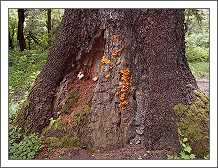
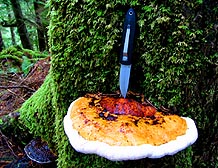
The white and orange growths on this Sitka Spruce indicate wood decay. Here, the growths are in exposed dead wood, not through the bark. If a cavity was larger, like 50% of the trunk circumference, eradication for safety is a higher priority..The decision to preserve or eradicate trees with cavities on the trunk, is best left to someone like a trained Arborist. The percentage of the trunk perimeter occupied by a cavity (or even dead dry wood) is critical. A cavity that goes 52% of the way around a tree trunk, is incomparable to a cavity that goes 15% of the way around a trunk.
The more of the circumference occupied by a cavity or decay, the greater the potential hazard.
Options may be elimination or preservation of the tree, based on the advice of a properly trained and experienced arborist.
The solution will vary according to the type of the tree, as well as the location and size of this weakness.
If the tree will remain, drilling holes to drain cavities, may damage a tree's natural defensive barriers. Likewise, carving, grinding or sawing material from decayed pockets may also damage a tree's established defensive barriers.
Loose material that can be easily scooped away with gloved hands, should be fine to remove.
5. HISTORY - GOOD HISTORY ? BAD HISTORY ? Has the trunk or stems been topped? Have you or your neighbors applied herbicides. Has the grade of the soil been changed, like fill soil for example? Have roots been damaged or cut, possibly from trenching or concrete work? Have new plants or a lawn been installed near the tree in the recent past? Were other big trees removed, increasing the intensity of available sunlight? Have any treatments been done in the area - non-tree-related - such as treating for moss on a roof or driveway?
Cross-cut tops from topping, are a potential cause of decay and decline. Sometimes, external decay fungi will not be visible.Is there evidence of lightening or sunburn damage? Has heavy equipment or livestock, been moving across the soil within the dripline (compaction)? Could farming practices, even plowing from decades ago, have caused subsurface compaction (tillage pan)? Is the tree of a particular genus and species with a history notorious for problems?
Certain changes during the life of a tree can rightfully introduce serious concerns about how safe a tree is. Evaluating the history of a tree's environment can be complex, and is best left to trained professionals.
The options to deal with a bad care history, will vary according to each bad condition, practice and choice that occurred in the past. If any remedies shall occur, those solutions are dependent upon gathering as much information as possible.
6. CRACKED TRUNKS / SPLIT WOOD. Cracks in bark can be totally natural and normal. Cracking or splitting or bark does not happen naturally to all species. Some trees, like beech, can have smooth bark for many years. But others, like Douglas fir, have bark that cracks (develops fissures), within 20 to 30 years. Cracks of fissures in the bark may be normal - maybe not, but bark fissures are not uncommon. This is one category of care where familiarity with species identification and developement are essential. Usually, visible cracks in the wood are not a good sign. If the trunk - the wood - is cracked, a decision must be made to either preserve, or eradicate the plant. Splits in the unions between leaders and limbs could fit in this category too.
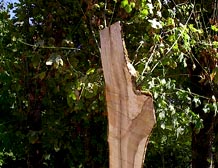
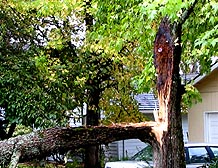
This sweet gum split apart in my own neighborhood at the end of summer during light rain and wind. It had a weak V shape union. If bracing was installed earlier, or had the extra leader been removed after planting, this could have been prevented.The size and type of the tree can completely alter the action to be taking. A 5' tall laceleaf Japanese maple with a crack in it's 8" DBH trunk, is not comparable to a 30' tall noble fir with a crack in it's 22" DBH trunk.
The crack alone, may not be the reason to save or eliminate a tree. It's the combination of the tree's size and type, and size of the crack, that determine the action to take. Likewise, the location of the crack or damage.
The best option may be culling the enire plant if the damage is severe. If the damage is minor, merely pruning a limb off, may do the job. Sometimes damage can be so minor that no parts need to be removed, allowing the tree to grow and produce more tissue.
Cabling, guying or the use of fastening hardware may be beneficial and required.
Final decisions and actions for cracks and splits are a task for a properly trained and experienced tree care professional like a Certified Arborist.
7. BROKEN OR HANGING BRANCHES. These are branches that cracked or broke, or "healed" poorly and are dangling by a thread so to speak. These may be alive or dead. Professional arborists may refer to these as hangers. Even limbs as small as 1 inch in diameter can be harmful or lethal. It's amazing how much speed a falling limb can gather.Extra haste should be made to remove these if they are located over playgrounds, sidewalks, benches and tables; areas where people linger for extended periods. A branch that is hung-up in a national forest canopy off the beaten path is not comparable to a broken branch suspended directly above a picnic table.
It's probably obvious to some people that large dead canopies are a sign of potential disintegration. Other people don't realize that the stems can disintegrate and fall.In most cases, broken or hanging branches should be removed.
One possible reason for delaying cutting it down, is the presence of wildlife, like a nest of birds held in place by the weak branch. Delaying eradication for this reason would depend on the location and the degree of hazard.
If a limb extraction need to be delayed due to wildlife, or any other reasonable exception, then signs, barricades and temporary fencing are an option to divert and warn people.
8. DEADWOOD. The name denotes that all of these branches are dead. Deadwood weakens with every day that passes, as its wood slowly decays or deteriorates. These should be removed before they fall. A limb can cause serious injury if it falls - especially if its water-soaked. Deadwood is often heavier in winter when wet, than in summer when dried out. These can fall during any season.
In spring, a dead wet limb can dry and shrink and dislodge, allowing it to fall. In summer, wind or small animals can dislodge limbs. In autumn, the weight of water from rain can bring limbs down, as moisture soaks into the dry wood, increasing its weight with accumulated water. In winter, snow, rain, wind, ice and animals, can all dislodge dead limbs. If a limb is large enough, it can cause great harm. Property damage from falling deadwood can be expensive too.
Deadwood is usually removed by pruning. This can be done any season of the year. On rare occasions, where deadwood is in riparian areas, or away from human activity, mandates may be present to leave the deadwood for wildlife. Excessive deadwood in the lower canopy can present a fire hazard.
9. SUSPENDED, DETACHED LIMBS OR STEM TOPS. Sometimes limbs and tree tops break loose and only fall a few feet, getting caught in the remaining parts of the tree, or in other trees. Sometimes they are hard to spot. Espcially the green ones that just broke off after a storm. And in winter, the broken living branches or tops, can stay green for weeks, possibly a couple of months.
This is a close-up of a conk. When these conks are visible on the outside of a tree, it's evidence of decay and weakness inside.Spend plenty of time viewing your trees from different angles as you look up and down throughout the entire canopy. Check your trees to make sure the tip of the leader, or tips or leaders, are still intact. If your tree is missing the skinny little leader tip, or even a section fo the tope, that may be a clue, or specific evidence, that a top is hung-up somewhere. If you knew there was a top, and its not on the ground after a storm, it has to be somewhere.
The stronger the storm, the further the broken tree parts can travel. Winds with speeds like 40 to 100 miles per hour, can carry limbs or trunk tops into nearby treetops, even to other properties. If you are certain that a trunk lost a large top, be sure to locate it. Suspended or detached limbs need to be removed from the canopy.
When a real threat exists of a detached limb hitting a climber, another solution should be sought. One potential solution includes a bucket truck or high lift machine. Detached limbs present a different situation or work environment from typical pruning for maintenance.
10. LARGE DIAMETER TRUNK OVER SMALLER. Some nursery plants are grafted, one variety on another, and there will be a variance of trunk diameter, large over small. This is common with cherry, Japanese maple, crapapple, beech, apple and many others. Usually, the taper of trunk diameter is gradual, with only a slight bit of taper as the eye moves up the trunk. Except maybe, the base of a giant sequoia or dawn redwood, which may widen dramatically at the base. Even so, a sequoia trunk taper is smaller diameter over larger diameter. And the increased girth of a Sequoia trunk as it flares down and outward into the soil, is a gradual widening of the trunk flare. But, what if your trunk is, for example, a 12" diameter trunk up to 5' above the ground, and then immediately at 5' above the ground, that trunk has an 16" diameter?
Deodar Cedar girdled by twine. The trunk is enlarged above the twine.Why is that? What is that? Sometimes a wire, rope, or other material was left on a trunk. Then as it grew, the bark and tissue engulfed the material wrapped around the trunk. What happened during that time, is that the roots sent nutrients up through the inner xylem or wood tissue to the leaves. Then the leaves made food from those nutrients feeding the top, but not the roots. That's because food from the leaves and photosynthesis, moves downward in the phloem just under the bark. And if that layer just under the bark gets "strangled" or constricted, the flow of food to the roots comes to a halt. In this case, the trunk, limbs and leaves just above the girdled area get fed, but the trunk and roots below the girdled area starve. It may take several years for a tree like this to die. Each year it gets weaker and can become more hazardous. The top gets bigger and heavier but the lower trunk supporting it stays almost the same size while slowly starving and getting weaker. In reality, the entire plant is being weakened but the upper trunk usually builds more wood tissue, whereas the lower trunk barely expands. Eventually the ailing lower trunk and root region weakens the upper canopy, and the living organism fails.
This kind of damage is either going to produce a weakened region in the trunk or associated problems like dead limbs. If the tree is not decayed and hazardous when we find a condition like this, it's almost innevitable that it will be dead and hazardous in the near future. Only a few species seem to survive girdling by naturally grafting a bridge of tissue. But if a trunk is girdled, and the diameter is larger above the girdle than below it, odds are that the plant is not overcoming the problem.
If, by some chance, a girdling wire, rope or hose, is not completely embedded in the trunk, try to remove it by severing the material. Pliers may be needed. This practice neccessitates that bark, cambium and phloem tissue are not ripped away, leaving another damage of near equal magnitude.
If the trunk diameter variation is due to a graft, there should be nothing to be worried about. Although, in some cases, there may be a graft incompatibility where the upper and lower sections did not graft or fuse properly. Recognizing a graft incompatibility usually requires experience.
11. SCORCHED TREE TOPS NEAR POWER LINES. Trees can conduct electricity. In many cases, utility companies will come and prune trees away from power lines for you. If the tops of the trees are touching the dangerous lines, call your electric company, and keep children from climbing the branches. In fact, keep them and anyone else, away from the tree. Sometimes the tips trees get scorched by the electric current. If you see that condition (scorched tips near power lines) you need a trained pruning professional who can handle that kind of operation. This is not homeowner work.
Don't be deceived by the size of power lines. Big power lines are not always more dangerous than the ones that look small and skinny. Many skinny lines are not placed so high on the power poles without a reason.
12. COMPLETELY DEAD. It should be obvious to almost anyone, that a big dead trunk and treetop can be hazardous. But many people don't understand that the dead wood can decay and weaken quickly. It may be because they have held lumber before and formulated an incorrect correlation between that lumber and a standing trunk. They may expect the dead trunks to keep standing and remain firm and rigid just like a board in their shed or treated wood fence post in their yard. But, dead trunks and limbs in the rain, wind, warm and cold, begin to decay and weaken. Often, heavy pieces come down in the winter, because weak wood soaks up rain water and becomes too heavy for it's weak point of attachment.
This aspect may become complicated due to the dead trunks left in some parks and riparian areas for wildlife habitat. Sometimes, this leads to decaying wildlife habitats close to areas where people are active. If dead trunks are kept near areas of human activity for whatever reason, those will need regular inspection.
13. CANOPIES BEING PRUNED - AT THE MOMENT. When you are having pruning done, by an amateur or a skilled Certified Arborist, consider that work site to be a potential hazard. Use caution whenever branches are being removed. Branches can land on an end, springing many feet from the landing zone. Limbs can be lowered on a rope, but that's not always the case. Little chunks of wood can get caught in the tree and fall at any time. Pieces of dead decayed wood can dislodge, and many are heavy enough to cause injury, even though they are dried out. Watching pruning is never a casual spectator sport. Observe from a safe distance, and let a pruning professional know you are in the vicinity. Standing next to a window when the tree being pruned is just outside the window, is not wise. Pets should not be secured near these trees, nor allowed to roam free in the area.
When big trees are being pruned by arborists, communication must be maintained between the supervisor, climbers, ground workers, homeowners, and pedestrians. Spotters or barricades may be needed. A property with adults or children on it, should be monitored regularly, to determine where everybody is at. Likewise with the workers, livestock and pets.
14. VERTICAL STRIPES OR STRIPS OF BARK DAMAGE. Lightning, or sunburn, can cause linear or vertical strips of damage to trunks and limbs. Some plants can last for years if the damage is not too severe. But when the bark and tissue below it is destroyed - even if it's a skinny area - the wood beneath can become exposed or begin to decay.
Sunburn damage can look similar to lightning damage and is usually exposed to south or west, whereas lightning damage can be in dense shade. This maple was one of 30 in a row all with sunburn. A result of no trunk protection after planting.
This is a potential sign of a hazard. The severity of the damage and decay will determine the degree of danger - if any.
A good solution, is an inspection by a properly trained horticulturist, or Certified Arborist, who can determine if removing or preservation is the best option.
15. GAP OR SPACE AROUND THE LOWER TRUNK. If a trunk has a gap of air or space between it and the surrounding soil, there may be a problem. In the warm season, soil around the trunk can dry and contract, leaving a small hollow space.
Other times, the gap may be due to poor soil conditions or an inferior root system, allowing the trunk to sway in multiple directions during windy or rainy weather - even when irrigation saturates the soil. These may not be leaning.
As the trunk rocks in every direction, is pushes soil to the side, pushing open an air gap that could be circular.
If the flare of the trunk is not detectable, and there is an air space around the trunk, that's even more reason to be concerned. This could be caused by planting too deep, too much irrigation combined with poor soil drainage in winter, or a damaged root system.
If a tree is very large, and it was planted too deep, raising the root system may not be possible. Lowering the grade around it is an option, but is frequently impractical. Replacement of the plant may be the best alternative.
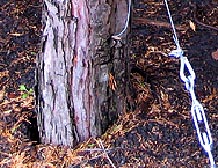
This is an incense cedar that some landscape company tried bracing in Lake Oswego, Oregon. See the space around the lower trunk? The tree is rocking in the wind and pushing soil away from it's trunk.16. FINE PARTICLES LIKE WOOD DUST, ON, OR BY THE TRUNK. Some trees like willow, for example, can be damaged by insects that chew or bore small holes and passageways beneath bark and in the wood. In time, the damage can lead to weakness or collapse. The dust or frass produced, is not similar to typical chainsaw chips. These fine particles are very small
A trunk that has been weakened by this damage should be removed. If the damage is minimal, consider pesticide or biological treatments if any are available. A properly trained and experienced professional should be involved.
17. EXCEPTIONALLY HEAVY CONES OR PLANT PARTS. This is an infrequent hazard, because it's limited to a small percentage of trees like the Auraucaria.
One species found in Australia, is Araucaria bidwillii, the Bunya-bunya , with cones as heavy as 8 to 15 lbs, with sharp spines. Its dioecious, with males and females. Only the ones with female flowers will produce the massive and potentially dangerous cones which develop high up in the canopy. Cone production in landscape situations exists, but is not common.
Other trees in the Araucaria genus may drop large cones, even for species with cones that are supposed to dissintegrate up in the canopy of leaves and branches. I found reports of occassional cone drop . There is also the Coulter Pine with cones of 2 to 3 pounds, native from California to Mexico.
Other than removal, solutions include signs, fencing or covers and arbors over pathways.
18. CHARRED TRUNKS & FIRE DAMAGE. This sign will be limited primarily to regions where wildfires occur occasionally, or have occured in the past.
Instead of conks produced by fungi, this trunk with decay has fungi producing mushrooms with caps.
If trees are discovered on a property, with charred trunks - most likely from a forest or brush fire - be sure to inspect it. See if the bark is firmly attached. Is just the outside of the bark charred, or can charcoal chunks be removed? Is the foliage discolored?
Some trunks may not be blackened, but may be damaged and even ooze pitch through the bark. The bark may be strangely spotted or colored on the fire side, and normal on side which faced away from the fire and heat.
Some trees can endure and survive many wildfires. But each one that has been in a wildfire, should be inspected. If too much heat penetrates the bark, tissue can be damaged and the tree can deteriorate. These should be checked periodically, especially immediately after a fire .
19. THE NAME OF A CERTAIN GENUS, PLUS THE AGE. Sometimes, the mere mention of a large tree's name can be a potential sign of hazards, based on previous problems known to be associated with the species. One example is Lombardy Poplar, notorious for large dead limbs when the trees age. Typically, the name can trigger suspicion when the trees are a bit older.